
Children’s Day: Remembering Nehru, Reclaiming the Lost Joy of Childhood
Dr Santosh Kumar Mohapatra
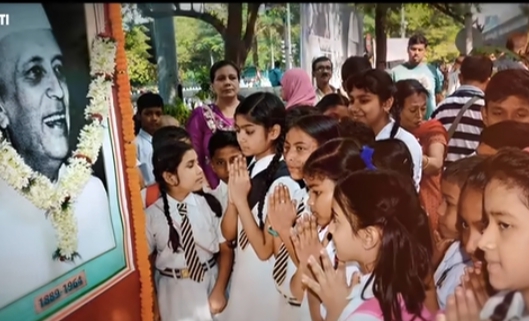
Children’s Day is not merely an occasion for ceremonial celebrations, speeches and photographs. It should be a day of introspection about how much importance we attach to children, their dreams, their freedom and their future. Jawaharlal Nehru, whose birthday on November 14 is celebrated as Children’s Day in India, had a deep affection for children and believed that they represented the hope and future of the nation.
Unfortunately, the man who once occupied a special place in the hearts of children is increasingly neglected, and his legacy is being systematically undermined in the prevailing political and ideological climate. Historical contributions should be evaluated objectively, not erased or distorted to serve contemporary political interests. More disturbing, however, is the changing nature of childhood itself.
Today’s children are growing up increasingly under the influence of smartphones, social media, online gaming and digital distractions. Their world is becoming dominated by screens, virtual friendships, online validation and the pressure to imitate unrealistic lifestyles.
The playground is gradually giving way to mobile screens, outdoor games to online entertainment, and meaningful human interaction to virtual engagement. Childhood, which should be a period of curiosity, creativity, innocence, friendship and unrestricted exploration, is increasingly being commercialised, monitored and controlled by digital platforms.
Children are exposed to cyberbullying, misinformation, harmful content, consumerism and unhealthy competition even before they develop the emotional maturity to understand or resist them.
They are physically present at home but often mentally absorbed in a virtual world. The irony is that while we celebrate Children’s Day, many children are losing the very freedom and joy that make childhood beautiful.
Remembering Nehru should therefore mean more than remembering a historical personality. It should mean defending scientific temper, secular values, education, curiosity, imagination and the right of every child to grow without fear, discrimination or exploitation.
We must protect children not only from poverty and social injustice but also from the unregulated influence of digital platforms. Let children enjoy their childhood rather than forcing them to grow up prematurely in a world driven by technology, competition and commercial interests.
A nation that neglects its history and fails to protect the childhood of its present generation cannot confidently claim to be building a better future.
The real tribute to Nehru would be to create a society where every child can dream freely, think independently, play joyfully and grow up with dignity.