

The Silent Reservoir: A Masterclass in Biological Design
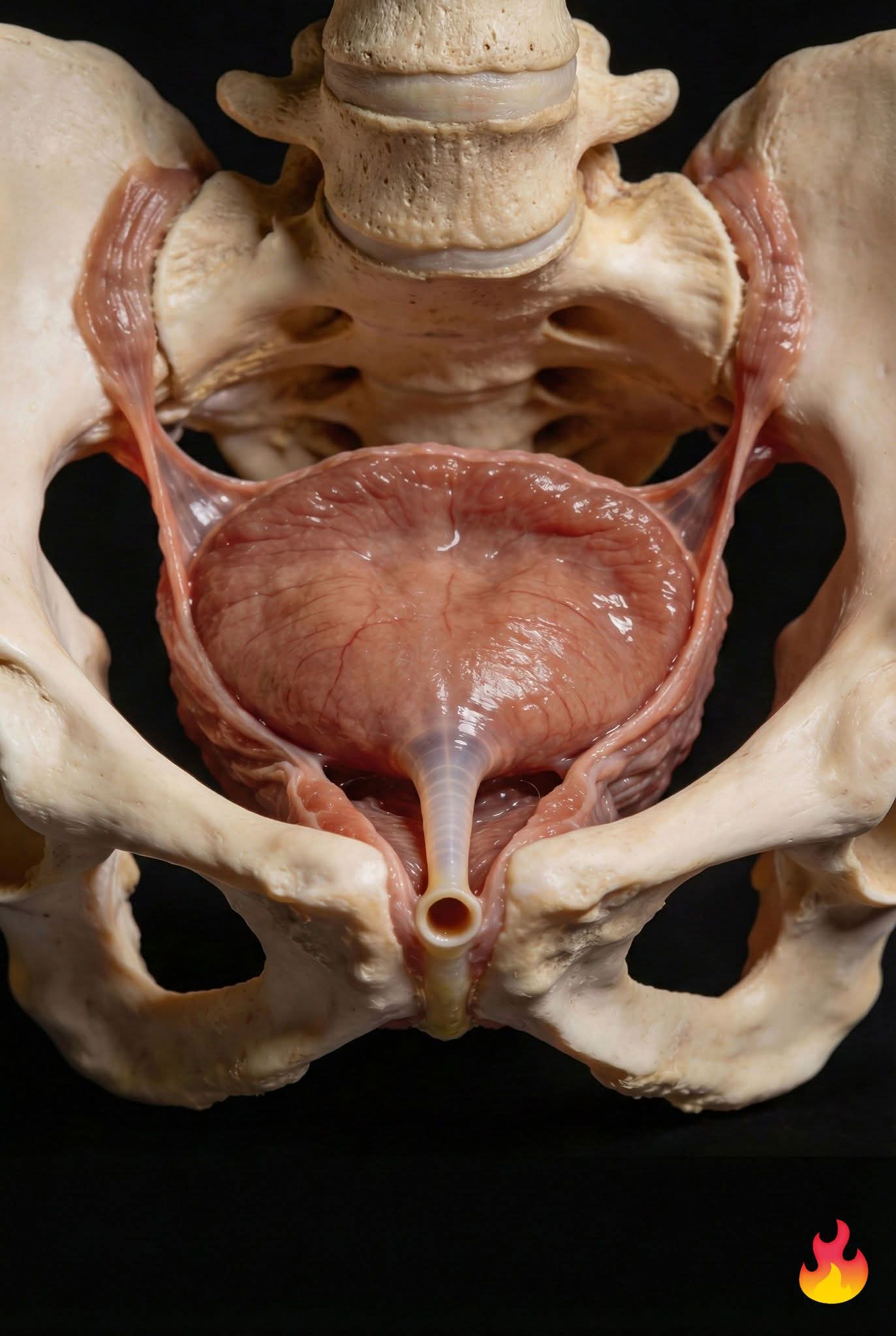
Deep within the protective fortress of the hip bones, there lies a silent guardian that dictates the rhythm of our daily lives more than we care to admit. Take a moment to look at this stunning 3D visualization. What you are seeing, nestled comfortably in the center of the pelvic “bowl,” is the urinary bladder—arguably the most underrated organ in the human body.
In this anterior view, the contrast is striking. You have the rigid, unyielding architecture of the pelvic girdle—the sturdy white bone acting as a protective cage. And sitting safely inside is the soft, muscular sac of the bladder, looking almost like a delicate fruit or a precious stone. But don’t let that softness fool you; this is an engineering marvel of elasticity and communication.
The texture you see on the surface hints at the powerful detrusor muscle. This isn’t just a passive storage bag; it is an intelligent, active vessel. When empty, it collapses into folds, hiding behind the pubic bone. But as it fills, it expands upward into the abdominal cavity, capable of stretching to hold up to half a liter (or more) of fluid while keeping the internal pressure low—a phenomenon called “compliance.”
Think of the coordination happening here. As the bladder stretches, nerves in that muscular wall fire signals to your brain saying, “It’s time.” Meanwhile, the sphincters at the bottom (where that small tube, the urethra, exits) must hold the line tight until you consciously give the command. It is a complex dance of autonomic and voluntary control that happens dozens of times a day without us even thinking about it.
We often take this system for granted until it sends us a frantic signal during a long movie or a road trip. But seeing it like this—isolated, pristine, and perfectly placed within the cradle of the skeleton—reminds us that our bodies are designed with incredible intention. Every curve of bone and fiber of muscle has a purpose.














Leave a Reply