

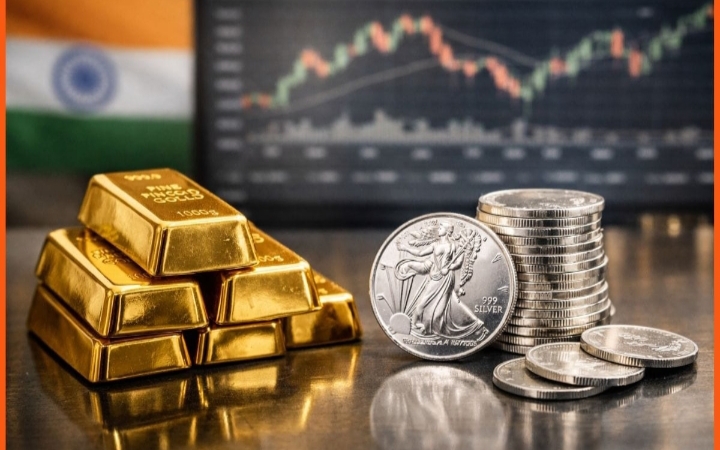
The Indian Bullion Market in March 2026: A Sharp Correction Amid Geopolitical Turbulence
Pradeep Kumar Panda Economist Darshan Samikhya Bhubaneswar
Gold and silver prices in India have experienced one of the steepest corrections of the decade between late February and late March 2026, with 24K gold declining 12–15% and silver falling 20–30% from intra-month peaks. This downturn, occurring in parallel with a 12–15% equity-market correction, stems from the same exogenous shocks: escalation of the US-Israel-Iran conflict, a surge in crude oil prices above $110–$119 per barrel, a hawkish US Federal Reserve stance, and a strengthened US dollar. Drawing on MCX futures data, spot prices, macroeconomic linkages, and historical precedents, this scholarly article examines the current state of the bullion market, identifies causal drivers, provides a layered forecast, and offers differentiated, evidence-based recommendations for two distinct stakeholder groups—long-term investors and end-consumers. The analysis concludes that the present correction represents a healthy unwinding within a structurally bullish secular cycle driven by inflation hedging, central-bank demand, and supply constraints.
Current State of Gold and Silver Prices in India (February 23 – March 23, 2026)
As of the close on March 23, 2026, the Indian bullion market reflects extreme volatility and significant price erosion. On MCX futures:
24K Gold: Trading in the range of ₹1,37,000–₹1,47,000 per 10 grams (spot equivalent ≈ ₹13,500–₹14,600 per gram). This compares with levels around ₹1,59,000–₹1,60,600 per 10 grams on or near February 23, implying a cumulative decline of 12–15%. Physical retail prices in major cities (Delhi, Mumbai, Kolkata) hover similarly after accounting for minimal making charges, with 22K jewellery-grade gold at ₹12,400–₹13,400 per gram.
Silver: More severely affected, with MCX futures in the ₹2,00,000–₹2,27,000 per kg band (spot ≈ ₹230–₹245 per gram). Earlier March peaks exceeded ₹2,75,000–₹2,85,000 per kg, representing a 20–30%+ correction in phases.
Single-session collapses were dramatic. On March 19–20 and especially March 23, gold futures dropped ₹11,000–₹14,000 per 10 grams (8–10%), while silver plunged ₹26,000+ per kg (11–12%), repeatedly hitting lower circuits. Total value erosion in open interest and physical holdings is estimated in the tens of thousands of crores. The parallel equity correction (Nifty 50 at 22,512.65, Sensex ≈72,700) and elevated India VIX underscore a broad risk-off environment. Domestic demand indicators—jewellery offtake and ETF inflows—have softened temporarily, though cultural buying (pre-wedding season) remains latent.
Causal Analysis: Macro Dominance Over Geopolitical Safe-Haven Demand
The correction is not a reversal of secular fundamentals but a classic macro-driven unwind. The primary catalyst was the rapid escalation of hostilities in West Asia from late February 2026, including reported strikes on Iranian infrastructure and retaliatory disruptions threatening the Strait of Hormuz. This propelled Brent crude to multi-year highs ($110–$119 per barrel), triggering global inflation fears.
Ironically, the very geopolitical tension that should have supported safe-haven buying instead produced the opposite short-term effect through two transmission channels:
Monetary tightening expectations: The US Federal Reserve’s March meeting maintained rates and signalled only limited cuts for 2026, citing energy-driven inflation. This strengthened the US dollar index and pushed 10-year Treasury yields higher, exerting downward pressure on non-yielding assets.
Risk-off contagion: Heavy FII selling in Indian equities spilled over into bullion via correlated liquidity withdrawal. Silver, with its dual industrial role (solar, electronics), suffered amplified losses due to weaker global manufacturing signals.
Empirical correlations confirm this: gold exhibited a strong negative relationship with the dollar index and positive correlation with real yields during the period.
Domestic amplifiers included rupee depreciation (near ₹92–94 per USD) and margin pressure on import-dependent sectors. Unlike pure safe-haven episodes (e.g., 2022 Russia-Ukraine crisis), the 2026 episode combined geopolitical risk with simultaneous monetary tightening and commodity inflation, producing a temporary negative feedback loop for precious metals.
Forecast: Near-Term Volatility, Medium-Term Structural Bullishness
Short-term outlook (next 1–4 weeks, through mid-April 2026) Bias: Sideways to mildly bearish with high volatility. Direction remains event-driven.
Gold: Support zone ₹1,35,000–₹1,40,000 per 10 grams; resistance ₹1,48,000–₹1,50,000. A breakdown below ₹1,35,000 risks extension to ₹1,30,000–₹1,32,000 if dollar strength persists. Relief rallies possible on any de-escalation headline.
Silver: Support ₹1,95,000–₹2,10,000 per kg (near 200-DEMA); resistance ₹2,40,000–₹2,56,000. Industrial weakness may keep silver underperforming gold on a relative basis.
Medium-term outlook (April–December 2026 and beyond)
A structural bullish reversal is highly probable once the immediate macro overhang dissipates. Key supportive forces include: Persistent geopolitical uncertainty and central-bank gold purchases (record levels observed globally in 2024–2025), Inflation hedging demand as oil effects linger and Silver-specific supply deficits and green-energy industrial offtake (solar PV, EVs).
Consensus forecasts (Motilal Oswal, Ventura, global banks) point to gold recovering toward ₹1,50,000+ per 10 grams by mid-2026 and potentially higher averages for the year. Silver could outperform percentage-wise, targeting ₹2,85,000–₹3,50,000 per kg in bull scenarios. Festival demand (Akshaya Tritiya, wedding season) from April onward provides a domestic tailwind. Historical parallels—post-2011, post-2020, and post-2022 corrections—show precious metals typically regain and exceed prior highs within 6–12 months after macro shocks subside.
Advice for Investors
Short-term posture (capital preservation): Exercise extreme caution. Avoid lump-sum entries; employ strict stop-losses on futures or ETF positions. Reduce leverage and maintain cash buffers.
Long-term strategy (horizon ≥1 year): Treat the current 12–30% correction as a generational buying opportunity. Recommended actions: Deploy systematic investment plans (SIPs) or systematic transfer plans (STPs) into gold/silver ETFs (Nippon India Gold ETF, HDFC Gold ETF), mutual fund schemes, or digital platforms (Groww, PhonePe, MMTC-PAMP), Maintain 5–15% portfolio allocation to precious metals as a natural hedge against equity volatility, inflation, and rupee depreciation, Prefer Sovereign Gold Bonds (where available) for tax-efficient interest plus capital appreciation and Silver suits higher-risk appetites seeking leverage to industrial recovery.
Monitor five variables daily: Brent crude, USD index, Fed dot-plot signals, India VIX, and West Asian headlines. Discipline and rupee-cost averaging have historically delivered superior risk-adjusted returns in Indian bullion cycles.
Advice for Consumers
For households purchasing jewellery, coins, bars, or gifting (weddings, festivals, cultural ceremonies), the March 2026 correction has rendered bullion materially more affordable than early-March peaks.
Timing: The present price band (gold ₹13,500–₹14,600/g; silver ₹230–₹245/g) offers an attractive entry relative to recent highs. However, avoid panic buying amid daily swings; stagger purchases over 2–4 weeks or wait for post-volatility stabilisation.
Product choice: For pure consumption (jewellery), negotiate making charges (target <8%) and insist on Hallmark/BIS certification. For value preservation alongside use, prefer coins/bars (24K gold, 999 silver) or digital gold/silver (Paytm, SafeGold) to eliminate storage and making costs.
Budget discipline: Limit purchases to genuine needs; jewellery carries 3% GST and resale discounts. Digital options allow gram-level buying from ₹1 onward, ideal for salaried or middle-income families.
Long-term consumer strategy: View bullion as part of intergenerational wealth (e.g., wedding jewellery, family heirlooms). Continue cultural practices but supplement with paper/digital forms for efficiency. Post-April festival demand may support prices; buying in tranches mitigates timing risk. Taxes remain straightforward: 3% GST on purchase; long-term capital gains (>24 months) at 12.5% without indexation for most forms.
The March 2026 correction in Indian gold and silver prices constitutes a textbook macro-induced drawdown within a fundamentally bullish multi-year cycle. Geopolitical risk, while temporarily overshadowed by monetary tightening and dollar strength, has not altered the secular drivers—persistent inflation hedging, central-bank accumulation, and silver’s industrial tailwinds. For investors, the present weakness is an opportunity for disciplined accumulation. For consumers, it is a window of relative affordability for culturally significant purchases.
In an era of heightened global uncertainty, precious metals retain their role as portfolio stabilisers and stores of value. Patience, diversification, and process-driven decision-making remain the cornerstones of success in the Indian bullion market. Investors and consumers alike should consult certified financial advisors or reputed jewellers for personalised guidance tailored to risk tolerance, time horizon, and household objectives.











Leave a Reply