

Odisha’s Metro Dream Lies in Ruins: BJP Government Burying Bhubaneswar’s Future
Pradeep Kumar Panda Economist Darshan Samikhya Bhubaneswar
Just 48 hours after the Odisha Cabinet formally scrapped the Bhubaneswar Metro Rail Project on April 4, angry commuters, urban planners and opposition leaders have launched a blistering attack on both the Union BJP government and the Mohan Charan Majhi-led Odisha BJP government. What began as a visionary 26-km elevated corridor linking Biju Patnaik International Airport to Trisulia Square in Cuttack – with 20 stations – has ended in a costly burial, leaving behind only ₹273.51 crore in sunk public money and a city still choking on traffic.
Critics say the cancellation is not just administrative failure but a classic case of political vendetta and policy hypocrisy. The project was conceived, planned and partially executed under the previous BJD government. After the 2024 power shift, the new BJP regime first pretended to “review” it, then quietly killed it – citing a rigid National Metro Rail Policy 2017 framed by the very same BJP-led Centre that now refuses to update or relax it.
A Project Born of Necessity, Killed by Politics
The idea of a metro or rapid transit system for the Bhubaneswar-Cuttack corridor had been floating since the early 2010s amid exploding urban congestion. On 27 July 2010, the Odisha Transport Department commissioned the Delhi Metro Rail Corporation (DMRC) for a feasibility study. By 2013, DMRC itself concluded that a full metro was not economically viable because the city agglomeration’s population was under 2 million and ridership projections were too low. A monorail alternative was briefly discussed but shelved. Planning stalled for years.
In January 2018, Chief Minister Naveen Patnaik revived the concept, envisioning a broader regional corridor (Cuttack–Bhubaneswar–Khordha–Puri) to fuel economic growth. The real momentum came on 1 April 2023 when Naveen Patnaik officially sanctioned Odisha’s first metro rail project on the state’s Foundation Day – Phase 1 from the airport to Trisulia.
DMRC was appointed on 26 April 2023 to prepare the Detailed Project Report (DPR). Soil testing, traffic, topographic, geo-technical, environmental and social impact assessments began on 11 July 2023. On 2 August 2023, the Bhubaneswar Metro Rail Corporation Limited (BMRCL) was established as a fully state-owned company. In a record four months, DMRC submitted the DPR on 16 August 2023 for a 26-km elevated line with 20 stations.
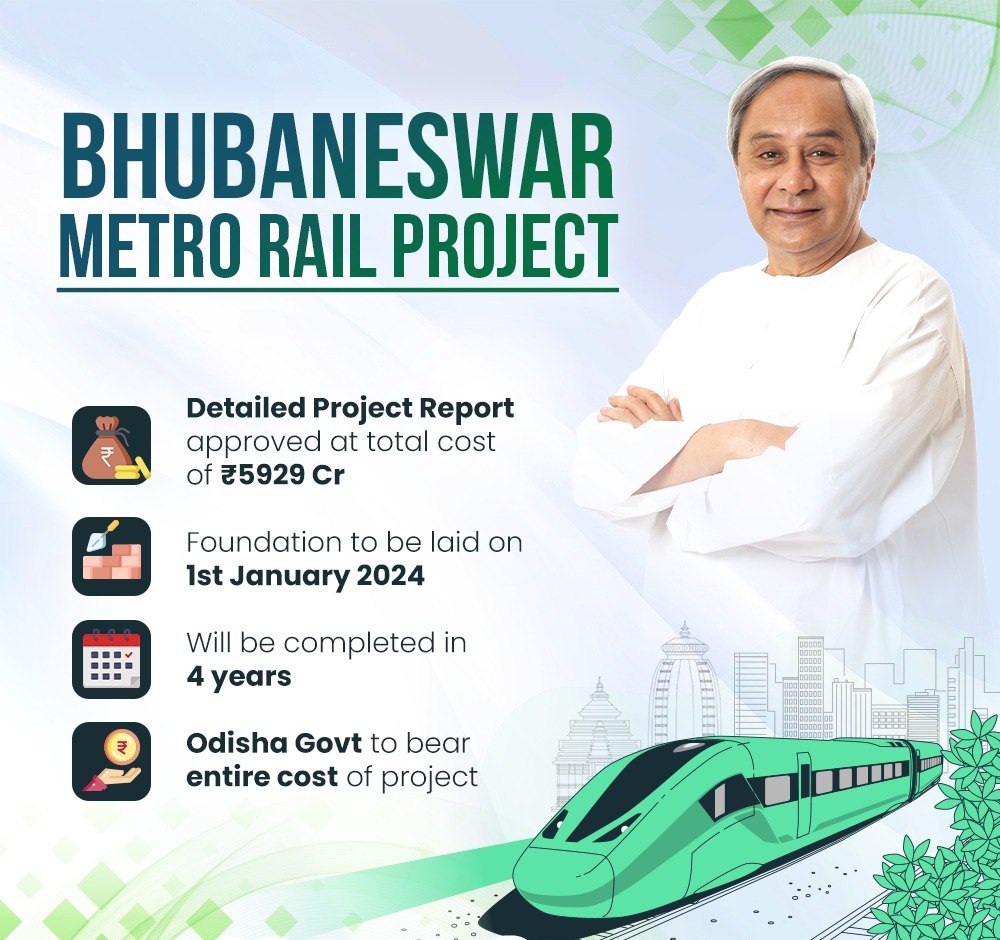
Chief Minister Naveen Patnaik approved the DPR on 7 October 2023 at an estimated ₹5,929 crore (later refined to ₹6,255.94 crore), fully funded by the state with a 48-month completion target. The state Cabinet gave its nod on 14 November 2023, and an MoU was signed the same month making DMRC the turn-key consultant for design, execution and supervision.
Foundation Stone, Tenders and Early Progress – Then Sudden Death
On 1 January 2024, Naveen Patnaik laid the foundation stone at Trisulia Square with much fanfare. The target was clear: infrastructure ready by December 2027, first metro rides by mid-2028. From March 2024 onwards, tenders were floated and awarded – major packages went to Ranjit Buildcon Ltd and Ceigall India Ltd for viaducts and stations, including the Nandan Vihar to Trisulia stretch. Hundreds of crores were committed.
Throughout 2024 and early 2025, preliminary work progressed: multi-site soil testing, setting up a precasting yard and casting unit at Ghatikia, minimal land acquisition, foundation design, and planning for depot and coach facilities. The government repeatedly reassured the public – December 2027 for infrastructure, mid-2028 for operations, 13 three-coach trains, and a projected 95,000 daily passengers.
The 2024 Power Shift: Review, Termination, Cancellation
Then came the 2024 assembly election and the BJP’s rise to power in Odisha. July 2025 marked the turning point. DMRC issued termination notices to contractors – Ceigall India Ltd received one around 25 July 2025, and similar notices went to others. Official disclosures bluntly stated “Employer has scrapped the project.”
The new BJP-led government formed an inter-ministerial committee to “review” feasibility. In July–August 2025, the minister publicly claimed the project was “not cancelled” – only tenders were terminated – and promised a revised, more viable DPR with central government support. In September 2025, the Assembly was told the project remained under review.
The charade ended on 4 April 2026. The Odisha Cabinet, chaired by Chief Minister Mohan Charan Majhi, approved retrospective expenditure of ₹273.51 crore incurred until 31 December 2025. It formally terminated the agreement with DMRC, put the project on hold and effectively scrapped it in its current form. BMRCL was repurposed merely as a nodal agency for a vague “Sustainable Urban Mobility Transition Plan.”
The reasons officially cited by the Inter-Ministerial Committee: non-compliance with the National Metro Rail Policy 2017, traffic demand and ridership below thresholds, and the risk of heavy annual operational losses. The government now talks of shifting to a Comprehensive Mobility Plan with Asian Development Bank assistance for the entire Bhubaneswar-Cuttack-Puri-Paradeep region, focusing on Transit-Oriented Development and multi-modal integration.
Double Standards and Hypocrisy at Both Ends
Opposition leaders and urban experts are unanimous in their condemnation. “The BJP at the Centre framed the 2017 Metro Policy that the Odisha BJP is now hiding behind,” said a senior BJD spokesperson. “Yet the same Centre celebrates the Delhi Metro – which DMRC itself runs and which posted an operating surplus of ₹412.79 crore in FY 2024-25 – and even smaller Kochi Metro, which has recorded three straight years of operating profit (₹33.34 crore in FY 2024-25). If Delhi and Kochi can run profitably, why was Bhubaneswar declared unviable before it even started running?”
The project never saw significant physical construction – only preliminary site preparation. Yet ₹273.51 crore of taxpayers’ money has vanished. Contractors who mobilised resources after winning tenders now face losses. The city’s swelling population and worsening congestion – the very problems the metro was meant to solve – remain unaddressed.
Critics point out that the project was 100% state-funded; the Centre bore no financial burden. Instead of supporting a growing Tier-2 capital or updating its own outdated 2017 policy, the Union BJP government allowed a rigid rulebook to become an excuse for cancellation. The Odisha BJP government, meanwhile, first spent public money on planning and tenders, then performed a U-turn within months of assuming power – a textbook case of sabotaging the previous regime’s legacy at the cost of public interest.
What Odisha Loses
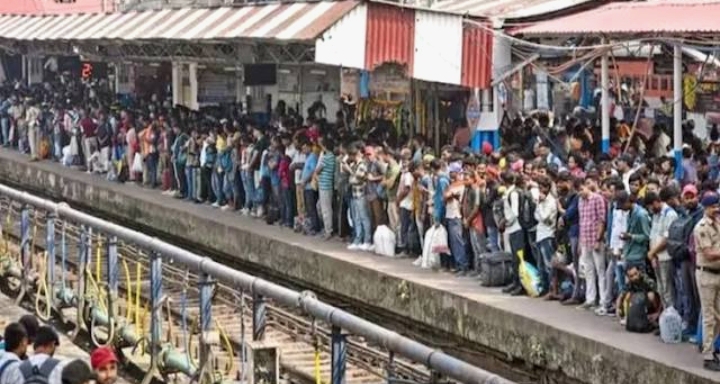
No metro rail exists in Odisha today. The ambitious regional corridor that could have transformed connectivity, boosted real estate, created thousands of jobs and eased traffic between Bhubaneswar and Cuttack has been replaced by yet another “study” and “comprehensive plan.” While other Indian cities move ahead with metro systems that eventually turn operationally profitable, Odisha’s capital is being told to wait indefinitely.
As one transport expert put it: “₹273 crore and four years of planning have been flushed down the drain not because the project was impossible, but because two BJP governments – one at the Centre enforcing a fossilised policy and one in the state executing a political kill order – chose short-term scoring over long-term vision.”
The people of Bhubaneswar and Cuttack are now left breathing polluted air in endless traffic jams, wondering how many more years – and how many more crores – will be wasted before their metro dream is allowed to breathe again.






Leave a Reply