

Press Release
“Kailakh Sanskrit Ratna Award 2025” to be conferred upon Prof. Shrinivasa Varakhedi
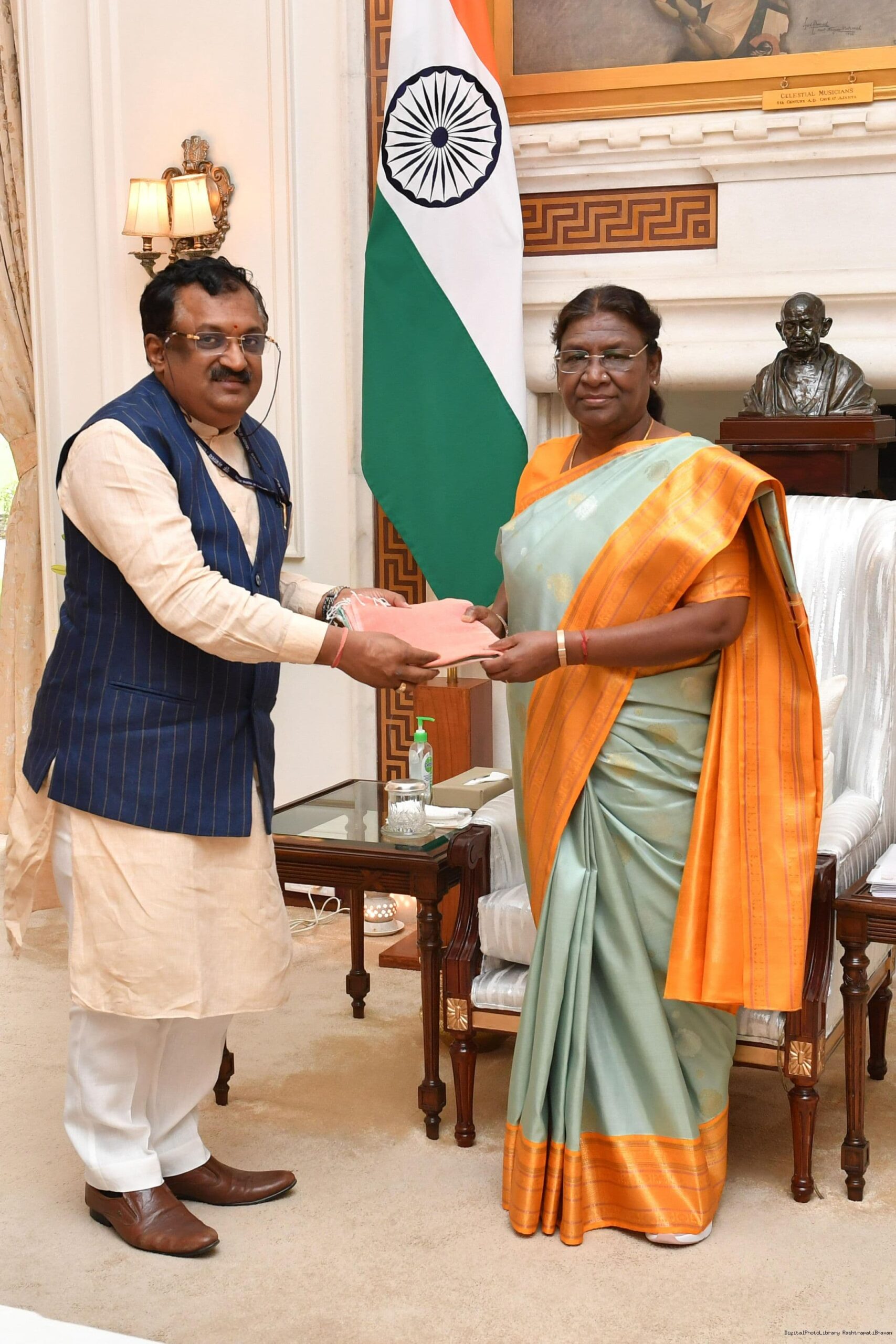
The Hon’ble Lieutenant Governor of Jammu & Kashmir, Shri Manoj Sinha Ji, will present this award.
Jammu & Kashmir: Shri Kailakh Jyotish avim Vedic Sansthan Trust’s chief, Mahant Rohit Shastri (State Awardee), issued a press statement announcing that the Kailakh Sanskrit Ratna Award 2025 will be conferred upon Prof. Shrinivasa Varakhedi, Vice-Chancellor of the Central Sanskrit University, New Delhi. He is being honoured for his remarkable contribution in promoting the divine Sanskrit language (Devavani) both within India and abroad.
Mahant Rohit Shastri informed that the Trust initiated the tradition of conferring the “Kailakh Sanskrit Ratna Award” in 2017 to honour scholars who have contributed exceptionally to the promotion of Sanskrit. This year, the Trust has decided to organize the award ceremony on 11 December 2025 at Majestic Grand Banquet Hall, Mishriwala, Jammu.
In this programme, the Hon’ble Lieutenant Governor of Jammu & Kashmir, Shri Manoj Sinha Ji, will be the Chief Guest, former minister Shri Sham Lal Sharma Ji will be the Special Guest, along with several other distinguished guests. The event will feature a Dogra exhibition, Sanskrit-based cultural performances, and a unique combined presentation of Dogra and Sanskrit traditions, which will be the main highlights.
Prof. Shrinivasa Varakhedi, Vice-Chancellor of the Central Sanskrit University, is an eminent scholar, researcher, and administrator in the fields of Sanskrit studies and computational linguistics. He holds a PhD in Nyaya Shastra and has nearly three decades of extensive experience in teaching, research, and academic administration. He has made significant contributions to Sanskrit through his leadership as Vice-Chancellor at several prestigious institutions including Kavikulaguru Kalidas Sanskrit University (Nagpur), Gondwana University, and Karnataka Sanskrit University. He has also served in key roles such as Registrar, Director, Dean, and Professor in various academic institutions, actively contributing to Sanskrit research and policy reforms.
Additionally, he served as a Research Associate at the Language Technology Research Centre, IIT Hyderabad, where he contributed to natural language processing research related to computer science, artificial intelligence, western logic, linguistics, and Indian scriptures. Under his visionary leadership, the Central Sanskrit University, New Delhi received the prestigious NAAC A++ grade, and the University was recognized as a Category-I Institution by UGC/Ministry of Education, Government of India. His guidance has been instrumental in transforming the university into a “world-class institution,” upholding the vision of making India a Vishwaguru and promoting Sanskrit education globally.
Prof. Varakhedi has received numerous honours from various institutions in India, including the Maharshi Badrayan Vyas Presidential Award (2007) conferred by the President of India, Dr. Goswami Giridhari Lal Sanskrit Gaurav Award (2024), Atal Ratna (2022), and many others. His other notable honours include D.Litt. (Vidya Vachaspati Samman) 2022, honorary degrees from Kavikulaguru Kalidas Sanskrit University, Uttarakhand Sanskrit University (D.Litt., 2024), Jagadguru Ramanandacharya Rajasthan Sanskrit University (Doctor of Literature, 2024), the Central Institute of Higher Tibetan Studies, Varanasi (Honorary Degree, 2025), and Desh Bhagat University, Punjab (Honorary Degree, 2025), among others.
An accomplished author and editor, Prof. Varakhedi has written 16 books, and has translated traditional Sanskrit methodologies into several Indian languages including Sanskrit, Marathi, Hindi, and Kannada. He has also contributed chapters to books written in multiple Indian languages and English. Continuing his pursuit of innovation in Sanskrit philosophy, Nyaya, linguistics, and logic, he has guided more than 25 scholars, including post-doctoral researchers, PhD candidates, M.Phil. students, and postgraduate researchers.
Prof. Varakhedi has served as visiting faculty at several prestigious institutions, enriching students and scholars with his deep knowledge. He was visiting faculty for “Indology and Buddhist Studies” at Sanchi University, Madhya Pradesh; Chinmaya University Peeth, Veliyanad, Kerala; School of Vedic Science, MIT Pune; Vedavigyan Gurukulam, Bangalore; Sri Ramakrishna Vivekananda University, Belur, Kolkata; and the Department of Philosophy at Rabindra Bharati University, Kolkata. He has organized numerous national and international seminars and delivered keynote addresses at more than 200 seminars, workshops, and events. Through these platforms, he has actively promoted the Indian knowledge tradition, religion, philosophy, cultural peace, Guru–Shishya parampara, Nyaya, and India’s intellectual heritage.
In recent years, he has served as chairman or active member of more than 110 national committees, academic bodies, and policy-making organizations. Notable among these are: Member of the Council and Governing Body of the Indian Council of Philosophical Research; Nominated Expert on the Selection Committee of Jawaharlal Nehru University, Delhi; Member of the Equivalence Committee, University of Delhi; Member of the Executive Council of Jagadguru Rambhadracharya Divyang University, Chitrakoot; Member of the Sanskrit Working Committee under the Ministry of Human Resource Development/UGC; Member of the Expert Committee of UGC; Member of the Academic Council of Banaras Hindu University; and Member of the Governing Board of the Institute of Eminence (IoE), University of Hyderabad.
He is also a founding member of the Sanskrit Digital Consortium, advisor to the Mahabharata Digitization Project at Manipal University, and participant in several innovative projects. Prof. Varakhedi works on various UGC committees, including the committee for preparation of Detailed Project Reports (DPR) for skill-based courses under NSQF; the committee for developing a roadmap for establishing the Oriental Studies Skill Council for Sanskrit development; the expert committee for standardizing PG certificate and diploma curricula in Manuscriptology and Archival Science; and the Indian Language Promotion Committee, which is dedicated to advancing Indian languages and knowledge systems.





Leave a Reply