

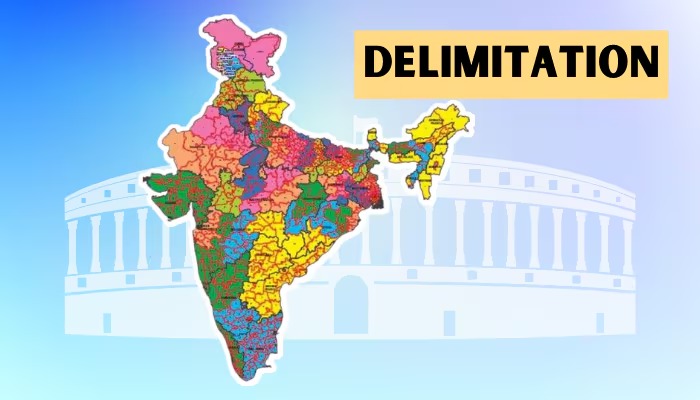
Chronology of Delimitation in India
Pradeep Kumar Panda Economist Darshan Samikhya Bhubaneswar
Delimitation in India is the constitutional process of redrawing the boundaries of parliamentary (Lok Sabha) and state legislative assembly constituencies to ensure roughly equal representation based on population changes, as mandated by Articles 82 (for Lok Sabha) and 170 (for state assemblies) of the Constitution of India. It is carried out by an independent Delimitation Commission appointed by the President, whose orders are final, non-justiciable, and laid before Parliament/state legislatures without modification. The process uses the latest census data to readjust seat allocation among states, divide states into territorial constituencies, and fix reservations for Scheduled Castes (SCs) and Scheduled Tribes (STs) under Articles 330 and 332.
The core objectives are equitable representation (one person, one vote principle), correcting malapportionment (unequal constituency sizes), and maintaining electoral integrity amid demographic shifts. However, political considerations—especially population control incentives and federal balance—have led to long freezes. Delimitation has occurred only four times nationally since independence (1952, 1963, 1973, 2002), with no exercises after the 1981 and 1991 censuses. A freeze imposed in 1976 (extended in 2002) kept total Lok Sabha seats at 543 (based on 1971 census figures) until the first census after 2026.
Below is a complete chronological history since independence (1947), including pre-formal commission steps, each exercise’s details, constitutional amendments, special cases (e.g., J&K and Assam), impacts, and the current/future status as of April 2026.
Pre-Independence Context and Immediate Post-Independence Setup (1947–1950)
• Under British rule, delimitation occurred periodically (e.g., 1935 Government of India Act), but these were limited and not based on universal adult suffrage.
• After independence (15 August 1947) and the Constitution’s enforcement (26 January 1950), the first general elections (1951–52) required new constituencies for universal adult franchise.
• 1950–51: The first post-independence delimitation was carried out directly by the President (with assistance from the Election Commission of India). This was an interim exercise under presidential orders (Delimitation of Parliamentary and Assembly Constituencies Order, 1951). It created initial boundaries for the first Lok Sabha and state assemblies ahead of the 1952 elections. Provisional population data led to approximately 489 Lok Sabha seats. This set the stage for the formal commission process.
- First Delimitation Commission (1952, under Delimitation Act, 1952; based on 1951 Census)
• Established: Via the Delimitation Commission Act, 1952—the first formal statutory framework.
• Chairperson: Justice N. Chandrasekhara Aiyar (retired Supreme Court judge).
• Key Changes:
o Lok Sabha seats increased to 494.
o State assembly seats adjusted accordingly (exact total not uniformly recorded but formed the baseline).
o Initial SC/ST reservations fixed proportionally.
o Focused on creating single- and double-member constituencies where needed.
• Process: Public consultations, population-based boundary drawing. Orders effective for 1952 elections.
• Impact: Established the foundational electoral map for independent India’s democracy. Ensured representation reflected early post-Partition demographics. - Second Delimitation Commission (1963, under Delimitation Act, 1962; based on 1961 Census)
• Context: Followed the States Reorganisation Act, 1956, which redrew state boundaries linguistically.
• Key Changes:
o Lok Sabha seats increased to 522.
o Shifted exclusively to single-seat constituencies (no more double-member seats).
o State assembly seats: 3,771.
o Updated SC/ST reservations based on 1961 population.
• Process: Commission worked post-1956 reorganisation to realign constituencies.
• Impact: Refined representation after linguistic state formation; addressed population growth in the first decade of independence. - Third Delimitation Commission (1973, under Delimitation Act, 1972; based on 1971 Census)
• Chairperson: Justice J.L. Kapur (retired Supreme Court judge).
• Key Changes:
o Lok Sabha seats increased from 522 to 543 (including addition for Sikkim).
o State assembly seats: 3,997 (including 32 for Sikkim).
o Final major interstate readjustment and seat increase before the long freeze.
o SC/ST reservations updated.
• Process: Completed amid political stability post-1971 census.
• Impact: Last exercise to expand total parliamentary strength significantly; reflected 1970s population boom.
The Freeze Era: 42nd Constitutional Amendment (1976) and Extensions
• 1976 (during Emergency): The 42nd Amendment froze the total number of Lok Sabha and state assembly seats based on the 1971 Census figures. Reason: To incentivize family planning/population control (southern states like Kerala, Tamil Nadu had succeeded, while northern states had higher growth). It prevented “penalizing” low-growth states by reducing their seats and avoided north-south political tensions/federal imbalance. Delimitation was suspended until after the 2001 census.
• No commissions after 1981 or 1991 Censuses: Purely due to the freeze; no boundary readjustments despite massive population shifts.
• 1980s–1990s Impact: Led to severe malapportionment—some constituencies had over 3 million voters, others under 50,000—undermining “one person, one vote.” - Fourth (and Last National) Delimitation Commission (2002–2008, under Delimitation Act, 2002; based on 2001 Census)
• Established: 12 July 2002.
• Chairperson: Justice Kuldip Singh (retired Supreme Court judge). Members included Chief Election Commissioner (or nominee) and state election commissioners.
• Key Features (due to ongoing freeze):
o No change in total Lok Sabha seats (remained 543) or inter-state allocation (still frozen at 1971 levels).
o No increase in overall parliamentary strength.
o Only intra-state boundary readjustment for more equal population per constituency.
o State assembly seats increased slightly to 4,123.
o SC/ST reservations readjusted based on 2001 population (proportional allocation within states).
• Additional Amendment: 87th Constitutional Amendment (2003) allowed further intra-state redistricting using 2001 census data for better equity.
• Process and Delays:
o Public sittings, draft proposals, objections heard.
o Supreme Court intervention (2007) due to delays; final orders approved by President Pratibha Patil on 19 February 2008.
o First elections under new boundaries: Karnataka Assembly (2008).
o Deferred for Assam, Arunachal Pradesh, Nagaland, Manipur, and Jharkhand (security/ other reasons; Jharkhand deferred till 2026).
• Impact: Corrected some population imbalances within states without altering national power balance. Orders non-justiciable.
Constitutional Extension of Freeze: 84th Amendment (2001–2002)
• Extended the 1976 freeze on total seats and inter-state allocation until the first census conducted after 2026.
• Allowed only limited boundary adjustments (as done in 2002–08).
• Current constituencies (as of 2026) are still based on 2001 census data for boundaries and 1971 for seat allocation.
Special/Regional Delimitation Exercises (Post-2002)
• Jammu & Kashmir (2020–2022): After Article 370 abrogation and J&K Reorganisation Act, 2019 (which created two Union Territories), a separate Delimitation Commission was formed (March 2020, chaired by Justice Ranjana Prakash Desai).
o Used 2011 census (exception to national freeze).
o Increased Assembly seats from 83 (effective) to 90 (plus 2 nominated).
o Added 6 seats to Jammu region, 1 to Kashmir region (final report: 43 in Jammu, 47 in Kashmir).
o First-time 9 ST-reserved seats.
o Parliamentary seats: All 5 equalized in assembly segments.
o Final order: 5 May 2022 (effective 20 May 2022). First used in 2024 Assembly elections. Controversial for alleged regional tilt but conducted as a one-time exercise.
• Assam (2023): Delimitation exercise completed (final order August 2023) using 2001 census data (as per ECI methodology; total seats unchanged at 126).
o Boundaries redrawn based on population density categories (A/B/C districts).
o Increased reserved seats (ST from 16 to 19; SC from 8 to 9).
o Significantly altered voter composition in minority/muslim-dominated areas (critics alleged “packing/cracking” affecting demographics).
o First used in 2024 Lok Sabha and 2026 Assembly elections. Sparked legal challenges and political debate.
Current Status (as of April 2026) and Future Outlook
• National Freeze Continues: No change in Lok Sabha (543 elected seats) or state assembly totals since 1971-based allocation. Boundaries from 2001/2008 exercise remain in force (except J&K and Assam adjustments).
• Next Delimitation: Mandated after the first census after 2026 (likely Census 2027, delayed from 2021 due to COVID/other factors). Expected to be the most transformative since 1971:
o Likely major increase in total seats (speculated ~816 in Lok Sabha).
o Significant north-south shift (northern states gain due to higher population growth; southern states fear loss of influence despite better population control).
o SC/ST reservations will be recalibrated.
o Possible constitutional amendments (e.g., using 2011 data for speed, aligning with women’s reservation under 106th Amendment).
• Challenges Ahead: North-south divide, federal tensions, urban-rural imbalances, and ensuring transparency/public participation. The process remains executive-driven with limited judicial review.
Delimitation has been crucial for India’s democratic evolution, adapting representation to demographic realities while navigating political sensitivities around population policy and regional equity. The upcoming post-2026 exercise will reshape Parliament and state legislatures for decades, potentially altering national politics profoundly. All past orders and reports are archived by the Election Commission of India for reference.


Leave a Reply